mirror of
https://github.com/teamchong/pxpipe.git
synced 2026-07-22 02:02:51 +02:00
 Steven Chong
379 lines
19 KiB
Markdown
379 lines
19 KiB
Markdown
# pxpipe
|
||
|
||
**Cut Claude Code's input tokens by rendering bulky context as images — the same system prompt, tool docs, and history, in a fraction of the tokens.**
|
||
|
||
An image's token cost is fixed by its pixel dimensions, not by how much text
|
||
is inside it. Dense content (code, JSON, tool output) packs ~3.1 chars per
|
||
image-token vs ~1 char per text-token on real Claude Code traffic. The
|
||
reader is the same vision channel that Anthropic's computer use already
|
||
relies on for screenshots. pxpipe is a local proxy that uses that channel
|
||
for context: it rewrites the bulky parts of each request into compact PNGs
|
||
before it leaves your machine. At current Fable
|
||
list prices that lands as a **~59–70% lower end-to-end bill** — but prices
|
||
move and workloads differ, so the durable number is the token cut itself,
|
||
measured per-request against a free `count_tokens` counterfactual in
|
||
`~/.pxpipe/events.jsonl`.
|
||
|
||
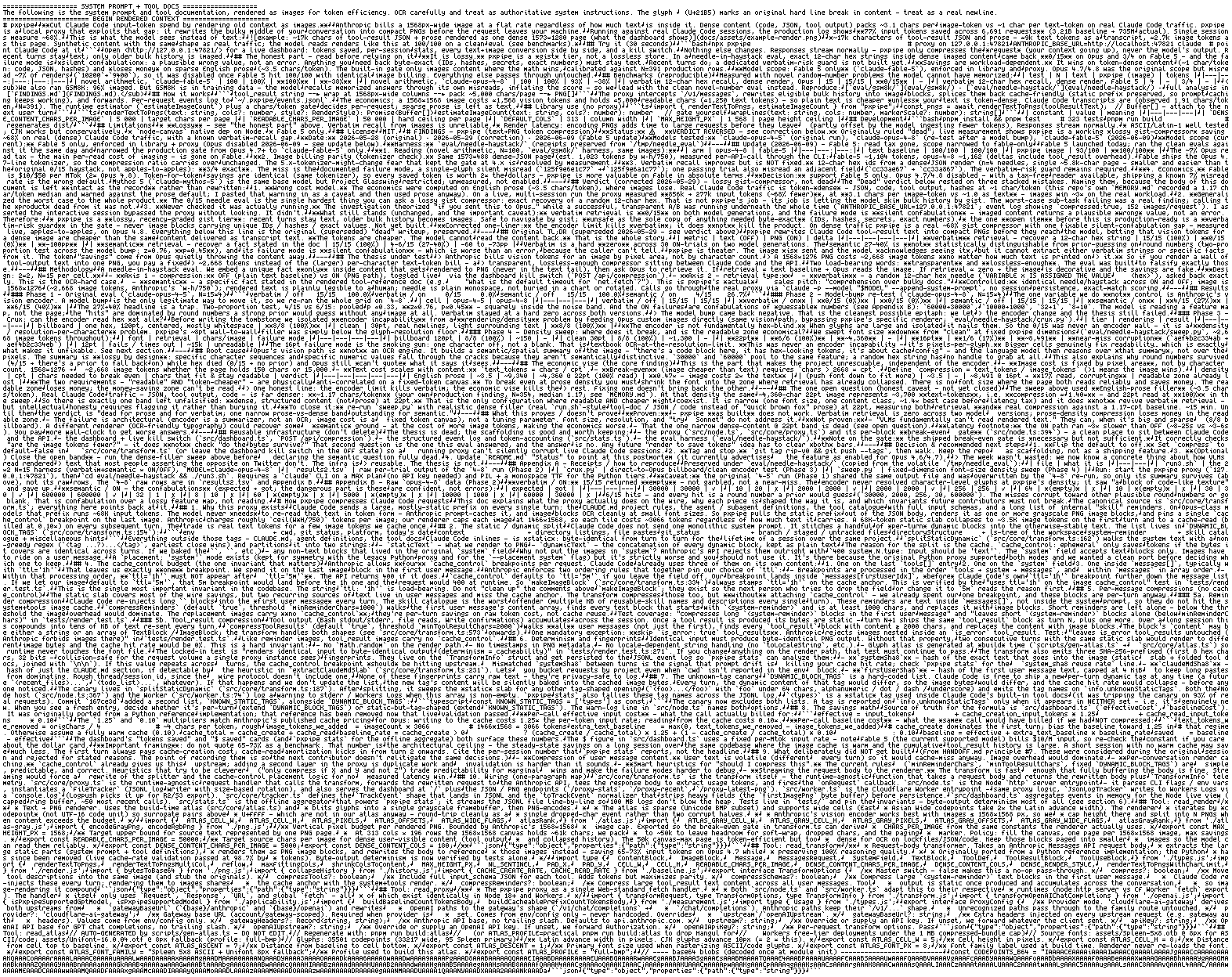
This is what the model sees instead of text:
|
||
|
||
|
||
|
||
*~48k chars of system prompt + tool docs: ≈25k tokens as text, ≈2.7k image
|
||
tokens as this page. Real pipeline output; the model reads renders like this
|
||
at 100/100 (see benchmarks).*
|
||
|
||
![chart: characters a frontier context window holds, 2018–2026 — vendor text series including Grok 4.5; orange measured overlay is Fable 5 [1m] + pxpipe ~18M (4.6×)](docs/assets/context-window-chars.png)
|
||
|
||
*Eight years of context growth, in characters. Every text line tops out near
|
||
~4M chars (a 1M-token window at ~4 chars/token); **Grok 4.5** is shown as a
|
||
text-window point only (500K). The orange overlay is the **same Fable 5 1M
|
||
window** read through pxpipe images — ~18M chars at the measured Anthropic
|
||
density (**4.6×** the text ceiling). Density is measured from a live render at
|
||
generation time, not hand-typed: regenerate with
|
||
`npx tsx scripts/gen-context-chart.ts`
|
||
([source](scripts/gen-context-chart.ts)).*
|
||
|
||
## Demo
|
||
|
||
**Fable 5 (the default, 100/100 reader) — plain left, pxpipe right:**
|
||
|
||
https://github.com/user-attachments/assets/1c8ee63a-fcd7-4958-917b-da788d718349
|
||
|
||
pxpipe counts an exact token **10/10** across 39 imaged filler files
|
||
(matches `grep` line-for-line), gets the multi-step ledger arithmetic right,
|
||
and ends the session at **$6.06** with context to spare (73.5k/1M) vs
|
||
**$42.21** at 96% full. One caveat visible in the clip: the pxpipe arm
|
||
needed a nudge to match the requested one-line output format.
|
||
|
||
**Opus 4.8 (disabled by default) — same layout:**
|
||
|
||
https://github.com/user-attachments/assets/f4e50137-31b5-426f-a6ed-b83f829b4a2c
|
||
|
||
Text needles read fine on both arms; the imaged phrase-count doesn't read on
|
||
Opus — and pxpipe **says so instead of fabricating a number**. That misread
|
||
rate is why Opus is opt-in.
|
||
|
||
## Try it (30 seconds)
|
||
|
||
```bash
|
||
npx pxpipe-proxy # proxy on 127.0.0.1:47821
|
||
ANTHROPIC_BASE_URL=http://127.0.0.1:47821 claude # point Claude Code at it
|
||
```
|
||
|
||
Dashboard at <http://127.0.0.1:47821/>: tokens saved, every text→image
|
||
conversion side by side, kill switch, live model chips. Responses stream
|
||
normally — pxpipe compresses the *request* only, never the model's output.
|
||
Recent turns stay text; the system prompt, tool docs, and older bulk history
|
||
are imaged.
|
||
|
||
Route different models through different providers while keeping one client
|
||
base URL:
|
||
|
||
```bash
|
||
ANTHROPIC_MODELS=claude-fable-5 \
|
||
OPENAI_MODELS=gpt-5.6-sol \
|
||
CLOUDFLARE_MODELS=moonshotai/kimi-k3 \
|
||
CLOUDFLARE_ACCOUNT_ID=... CLOUDFLARE_API_TOKEN=... \
|
||
npx pxpipe-proxy
|
||
```
|
||
|
||
The lists contain comma-separated exact model IDs. Listed models route to the
|
||
corresponding Anthropic Messages, OpenAI Responses, or Cloudflare-compatible
|
||
Chat Completions upstream; overlapping entries fail at startup. Unlisted
|
||
models retain pxpipe's normal family routing, so Claude, OpenCode, and Codex
|
||
can share the proxy. `OPENAPI_URL` and `OPENAPI_API` may replace the derived
|
||
Cloudflare endpoint and token.
|
||
|
||
## Offline export (no proxy)
|
||
|
||
You can render text, files, or diffs to PNG pages without running the proxy or
|
||
connecting Claude Code:
|
||
|
||
```bash
|
||
pxpipe export src/
|
||
cat prompt.txt | pxpipe export --stdin
|
||
pxpipe export --git
|
||
```
|
||
|
||
Each run writes a fresh `pxpipe-export-XXXXXX/` output folder (the exact path
|
||
is printed when the command finishes) containing `page-*.png`, `factsheet.txt`,
|
||
`manifest.json`, and `prompt.txt`. Upload the PNG pages and paste the prompt
|
||
into image-upload clients such as Cursor when you want dense visual context
|
||
without running the proxy.
|
||
|
||
## The honest part
|
||
|
||
- **It is lossy.** Exact 12-char hex strings in dense imaged content:
|
||
**13/15** on Fable 5, **0/15** on Opus, and **0/15** on Sol — misses are *silent
|
||
confabulations*, not errors. Byte-exact values (IDs, hashes, secrets)
|
||
must stay text; recent turns do. A dedicated verbatim-risk guard is not
|
||
built yet.
|
||
- **Escape hatch:** subagents on non-allowlisted models pass through as
|
||
text — route byte-exact work there
|
||
(`CLAUDE_CODE_SUBAGENT_MODEL=claude-sonnet-4-6`, or `model: sonnet` in
|
||
agent frontmatter).
|
||
- **Real work:** SWE-bench Lite pilot **10/10 both arms** at −65% request
|
||
size; SWE-bench Pro **14/19 ON vs 15/19 OFF** at −60%, verdicts agree
|
||
18/19, and the single split re-resolved 3/3 on replication — run-to-run
|
||
variance, not compression. Small n; receipts in `eval/`.
|
||
- **Workload-dependent.** Wins on token-dense content (~1 char/token),
|
||
loses money on sparse prose (~3.5 chars/token); a profitability gate
|
||
(calibrated on N=391 production rows) images only where the math wins.
|
||
- **Client-dependent.** Savings track uncached bulk the client still
|
||
re-sends as text. Claude Code re-sends system + tools + history on
|
||
`/anthropic/messages` and typically lands ~60–70%. Details and measured
|
||
splits: [docs/CACHING_AND_SAVINGS.md](docs/CACHING_AND_SAVINGS.md).
|
||
- **Model scope:** default `PXPIPE_MODELS=claude-fable-5`. Sol, Opus
|
||
4.7/4.8, GPT 5.5, and **Grok** are opt-in only (dashboard chips or
|
||
`PXPIPE_MODELS`) — not good enough as silent defaults for imaged context.
|
||
Grok packing + factsheet helps exact IDs, but quality remains below Fable:
|
||
82/100 arithmetic, 83/98 gist, and 13/18 state tracking. The exact Sol id
|
||
still matters. Sibling variants such as `gpt-5.6-terra` do not
|
||
inherit Sol's allowlist or render profile. `PXPIPE_MODELS=off` disables
|
||
imaging. Everything else passes through byte-identical. On the GPT path,
|
||
tool definitions stay native JSON and no Anthropic `cache_control`
|
||
markers are used. Responses history compression recognizes adjacent completed
|
||
`function_call`/`function_call_output` pairs: only old closed pairs are imaged;
|
||
the newest six completed pairs, every open call, and malformed/orphan state
|
||
remain native. The default history budget is 32 images; opt-in long-session
|
||
coverage can be raised (defensive cap 100) with
|
||
`PXPIPE_GPT_HISTORY_MAX_IMAGES=48` after validating the provider's request cap.
|
||
- **Per-model rendering:** opt-in `gpt-5.6-sol` uses a 152-column,
|
||
5×8 Spleen profile; Claude keeps its 312-column 5×8 Spleen profile. These
|
||
are selected by exact model id, including history pages and profitability
|
||
math. **Sol quality:** production 5×8 scored 98/100 arithmetic and 83/98
|
||
gist, 17/18 state, 4/16 never-stated confabulations,
|
||
and 0/15 dense hex. Exact IDs therefore use the verbatim factsheet, and recent/open tool state stays native.
|
||
[Sol receipts](eval/sol-profile/QUALITY_RESULTS.md) and
|
||
[profile evidence](docs/MODEL_RENDER_PROFILES.md).
|
||
- **Grok 4.5 (opt-in):** same production recipe as Sol (5×8 Spleen, IDS, text
|
||
factsheet; Grok strip maxH 512). Off by default (not Fable-level pure-image).
|
||
Measured production results are 82/100 arithmetic, 83/98 gist, and 13/18
|
||
state tracking. Enable with
|
||
`PXPIPE_MODELS=claude-fable-5,grok-4.5` or the dashboard chip.
|
||
[eval/grok-density/QUALITY_RESULTS.md](eval/grok-density/QUALITY_RESULTS.md).
|
||
|
||
## Benchmarks (reproducible)
|
||
|
||
### Model quality (does the model read the images?)
|
||
|
||
Every model row below uses the model's production profile unless a pure-image
|
||
research arm is called out. Sol uses **5×8 Spleen + adjacent text factsheet**;
|
||
the rejected RGB-overprint research remains documented under `eval/sol-profile`.
|
||
Claude numbers are novel problems the model cannot have memorized. Sol and Grok
|
||
quality use Codex’s Responses provider; Kimi K3 uses Cloudflare's
|
||
OpenAI-compatible transport through pxpipe; Fable/Opus use Claude. Token deltas
|
||
compare matched input arms: negative saves tokens; positive costs more. The
|
||
historical GSM8K run measured −38%, but it is a different corpus and is not
|
||
used for these novel-arithmetic rows.
|
||
|
||
| test | model | N | pxpipe (image) |
|
||
| --- | --- | ---: | ---: |
|
||
| novel arithmetic | `claude-fable-5` | 100 | **100%** |
|
||
| novel arithmetic | `gpt-5.6-sol` | 100 | **98%** |
|
||
| novel arithmetic | `claude-opus-4-8` | 100 | 93% |
|
||
| novel arithmetic | `grok-4.5` | 100 | **82%** |
|
||
| novel arithmetic | `moonshotai/kimi-k3` | 100 | **79%** |
|
||
| gist recall A/B (decisions, values, paths, names, negations; distractors; 15k–45k char sessions) | Fable 5 | 98/arm | **98/98** |
|
||
| same gist corpus, production images + factsheet | `gpt-5.6-sol` | 98 | **83/98** |
|
||
| same gist corpus, production images + factsheet | `grok-4.5` | 98 | **83/98** |
|
||
| same gist corpus, production images + factsheet | `moonshotai/kimi-k3` | 98 | **84/98** |
|
||
| state tracking (value mutated 3×, final/first/count) | Fable 5 | 18/arm | **18/18** |
|
||
| same state-tracking corpus | `gpt-5.6-sol` | 18 | **17/18** |
|
||
| same state-tracking corpus | `grok-4.5` | 18 | **13/18** |
|
||
| same state-tracking corpus | `moonshotai/kimi-k3` | 18 | **15/18** |
|
||
| confabulation on never-stated facts (lower is better) | Fable 5 | 16/arm | **0/16** |
|
||
| same never-stated probes (lower is better) | `gpt-5.6-sol` | 16 | **4/16** |
|
||
| same never-stated probes (lower is better) | `grok-4.5` | 16 | **0/16** |
|
||
| same never-stated probes (lower is better) | `moonshotai/kimi-k3` | 16 | **1/16** |
|
||
| verbatim 12-char hex, dense render | Opus | 15 | **0/15** |
|
||
| verbatim 12-char hex, dense render | Fable 5 | 15 | **13/15** |
|
||
| verbatim 12-char hex, same dense pages | `gpt-5.6-sol` | 15 | **0/15** |
|
||
| verbatim 12-char hex, same dense pages | `grok-4.5` | 15 | **0/15** |
|
||
| verbatim 12-char hex, same dense pages | `moonshotai/kimi-k3` | 15 | **0/15** |
|
||
|
||
**Harness split:** Fable/Opus quality and SWE-bench rows use **Claude**; Sol and Grok quality use
|
||
**Codex’s Responses provider** (`OPENAI_BASE_URL`). Kimi K3
|
||
used the same novel-arithmetic corpus and production renderer through pxpipe's
|
||
Cloudflare Messages bridge — see the
|
||
[`K3 receipt`](eval/sol-profile/model-moonshotai_kimi-k3-novel-arithmetic-results.json) and
|
||
[`eval/grok-density/QUALITY_SUITE.md`](eval/grok-density/QUALITY_SUITE.md).
|
||
|
||
K3 semantic and exact-recall receipts:
|
||
[`gist/state/guards`](eval/sol-profile/gist-recall-moonshotai_kimi-k3-results.json) and
|
||
[`dense hex`](eval/sol-profile/verbatim-hex-moonshotai_kimi-k3-results.json).
|
||
|
||
Sol receipts: [`eval/sol-profile/QUALITY_RESULTS.md`](eval/sol-profile/QUALITY_RESULTS.md).
|
||
Grok receipts: [`eval/grok-density/QUALITY_RESULTS.md`](eval/grok-density/QUALITY_RESULTS.md).
|
||
SWE-bench is not copied to Sol: its runner is Claude Code/Fable-specific
|
||
(`ANTHROPIC_BASE_URL`, Claude CLI, official Docker grading), and no Sol ON/OFF
|
||
run exists yet. Pure-image-only is **not** Fable-grade on live Grok.
|
||
|
||
### Capacity / density (how many chars per vision-token?)
|
||
|
||
Measured by rendering this repo’s dense fixture through the real pipeline and
|
||
pricing pixels at each family’s vision rate. Multiplier = measured
|
||
chars/vision-token ÷ 4 (prose text baseline). Not a model-quality score.
|
||
|
||
| family | window | as text (@4 c/tok) | as pxpipe images | density | multiplier |
|
||
|---|---:|---:|---:|---:|---:|
|
||
| **`claude-fable-5[1m]`** (default) | 1M | ~4.0M | **~18.3M** | ~18.3 c/vt (px÷750) | **~4.6×** |
|
||
|
||
Regenerate: `npx tsx scripts/gen-context-chart.ts` · chart PNG
|
||
[`docs/assets/context-window-chars.png`](docs/assets/context-window-chars.png).
|
||
|
||
SWE-bench run totals, receipts, and caveats:
|
||
[`eval/swe-bench/`](eval/swe-bench/) ·
|
||
[`eval/swe-bench-pro/`](eval/swe-bench-pro/) ·
|
||
[`eval/needle-haystack/`](eval/needle-haystack/) ·
|
||
[`eval/gist-recall/`](eval/gist-recall/) ·
|
||
[`eval/grok-density/`](eval/grok-density/) · analysis in
|
||
[`FINDINGS.md`](FINDINGS.md). (GSM8K scored 96% imaged, but it's in training
|
||
data — memorized answers survive misreads — so we lead with the novel-number
|
||
evals.)
|
||
|
||
## How it works
|
||
|
||
```
|
||
model id ──► render profile ──► wrap/reflow bulk context ──► PNG[] + exact-token factsheet
|
||
```
|
||
|
||
The proxy intercepts `/v1/messages`, rewrites eligible bulk into image
|
||
blocks, splices them back cache-friendly (static prefix preserved, prompt
|
||
caching keeps working), and forwards. Every enabled model gets the same
|
||
production stack: 5×8 Spleen pages, in-image IDS block, and adjacent text
|
||
factsheet. Claude uses 1568×728 pages; GPT 5.6 Sol uses 768px-wide portrait
|
||
strips; opt-in Grok 4.5 uses 152-col strips (maxH 512). A
|
||
per-request estimator uses that same resolved profile, so sparse prose stays
|
||
text. Events log to `~/.pxpipe/events.jsonl`.
|
||
|
||
## Library use (no proxy)
|
||
|
||
```ts
|
||
import { renderTextToImages, transformAnthropicMessages } from "pxpipe-proxy";
|
||
|
||
const { pages } = await renderTextToImages(toolResultText); // pages[i].png: Uint8Array
|
||
const { body, applied, info } = await transformAnthropicMessages({
|
||
body: requestBytes,
|
||
model: "claude-fable-5",
|
||
});
|
||
```
|
||
|
||
`options.keepSharp(block)` pins blocks as text; `options.emitRecoverable`
|
||
returns the originals of imaged blocks. Pure-JS runtime (Node and
|
||
edge/Workers); `@napi-rs/canvas` is build-time only. Full API:
|
||
`src/core/index.ts`.
|
||
|
||
## Development
|
||
|
||
```bash
|
||
pnpm install && pnpm test
|
||
pnpm run build # regenerates dist/
|
||
```
|
||
|
||
Windows is community-supported: primary development targets macOS/Linux, and Windows-specific fixes rely on contributor PRs (thanks @makoribrian).
|
||
|
||
## FAQ
|
||
|
||
**Is the headline end-to-end, or only on the requests you touched?**
|
||
End-to-end, the whole bill. Most compression tools report savings only on
|
||
the input slice they touched, which flatters the number. The end-to-end
|
||
denominator is *every* production request: the small ones pxpipe correctly
|
||
left untouched, all cache writes and reads, and all output tokens (which the
|
||
proxy never compresses). On a 13,709-request snapshot that was 59% ($100 →
|
||
~$41); a later 8,904-compressed-request trace measured ~70%. Compressed-only
|
||
runs higher (~72–74%) and is quoted separately, never as the headline. The
|
||
exact figure is workload-dependent — reproduce it on your own log.
|
||
|
||
**How is the math measured?**
|
||
Both sides of the same request, at the same moment. For every `/v1/messages`
|
||
POST the proxy fires a free `count_tokens` probe on the original uncompressed
|
||
body (the counterfactual) in parallel with the real forward, and reads
|
||
Anthropic's actually-billed usage block off the response. Both land in the
|
||
same row of `~/.pxpipe/events.jsonl`, so there is no turn-count or
|
||
run-to-run confound. Dollar conversion uses Fable 5 list ratios: input ×1.0,
|
||
cache write ×1.25, cache read ×0.1, output ×5. Cache pricing is applied
|
||
identically to both sides, so the caching discount cancels and cannot be
|
||
double-counted as "savings". Re-derive it yourself from the events log: the
|
||
formula and field names are documented in `src/core/baseline.ts`.
|
||
|
||
**What does it actually compress?**
|
||
Three kinds of *input* blocks, each behind a profitability gate:
|
||
|
||
1. large `tool_result` bodies (file reads, command output, logs) above
|
||
~6k chars of token-dense content
|
||
2. older collapsed history: turns behind the live tail get re-rendered as
|
||
image pages, recent turns always stay text
|
||
3. the static cacheable system prompt + tool docs slab; appended non-cacheable
|
||
system blocks stay live text so host custom instructions keep system-level
|
||
salience
|
||
|
||
Everything else passes through byte-identical: your messages, recent turns,
|
||
the model's output (it is the response, the proxy never touches it), sparse
|
||
prose, and anything too small to win. Fable 5 is the only built-in default. Sol,
|
||
Opus, GPT 5.5, and Grok remain explicit opt-ins. Sol's production 5×8 run
|
||
scored 98/100 arithmetic, 83/98 gist, 17/18 state, 4/16
|
||
never-stated confabulations, and 0/15 dense hex. Grok scored 82/100
|
||
arithmetic, 83/98 gist, and 13/18 state.
|
||
|
||
**Has it ever failed for real, outside the benchmarks?**
|
||
Yes, once in weeks of daily use: the model recalled a person's name from
|
||
imaged chat history and got it confidently wrong. No error, just a
|
||
plausible wrong name. That is the documented failure mode: exact strings
|
||
in imaged content are not byte-safe. Coding sessions tolerate this because
|
||
the agent re-reads files before editing; pure chat recall has no such check.
|
||
This failure mode is measured, not anecdotal:
|
||
[the legibility audit](docs/LEGIBILITY-AUDIT-2026-07-01.md) quantifies
|
||
exact-string recall off rendered pages (blind reads top out at 63% on dense
|
||
identifiers, with every miss predicted by a glyph-confusability matrix) and
|
||
documents the shipped mitigations — page geometry clamped to the API's
|
||
resample cap so billed pixels actually reach the vision encoder, and exact
|
||
identifiers (SHAs, numbers) riding alongside as text.
|
||
|
||
**Why are misses silent confabulations instead of read errors?**
|
||
Because model vision is not OCR: the image becomes patch embeddings, never
|
||
discrete characters, so there is no per-glyph confidence to fail loudly
|
||
on. When pixels underdetermine a glyph, the language prior fills the gap
|
||
with something plausible. Mechanism and receipts:
|
||
[docs/NOT-OCR.md](docs/NOT-OCR.md).
|
||
|
||
**Didn't DeepSeek-OCR show this doesn't hold up in practice?**
|
||
No: it proved the channel works, using an encoder/decoder pair trained for
|
||
the job. The skepticism dates from October 2025, when no stock production
|
||
model could read dense renders; that changed with Fable 5 (0/15 verbatim
|
||
hex on Opus 4.8 vs 13/15 on Fable 5, same pages). Timeline and per-model
|
||
numbers: [docs/NOT-OCR.md](docs/NOT-OCR.md).
|
||
|
||
**Why does the README read like an AI wrote it?**
|
||
Because one did. Most of this repo's commits — the code and the docs — were
|
||
authored by Opus/Fable agent sessions running behind pxpipe itself, reading
|
||
their own collapsed history as image pages while they worked.
|
||
|
||
## Limitations
|
||
|
||
- Lossy (above); verbatim recall from images is unreliable.
|
||
- PNG encoding adds latency to large requests before they leave.
|
||
- ASCII/Latin-1 well tested; CJK works but conservatively.
|
||
|
||
## Roadmap
|
||
|
||
Rendering research is parked as of 2026-07-05: verbatim misreads are
|
||
capacity-bound, not trick-bound, so no font/color/layout change fixes
|
||
exact-string recall at profitable density. The why is in
|
||
[docs/NOT-OCR.md](docs/NOT-OCR.md); the dated analysis and the three
|
||
documented follow-up threads (glyph-style A/B with banked pages, runtime
|
||
canary + re-fetch, surrogate-reader pre-flight) are in
|
||
[FINDINGS.md](FINDINGS.md), 2026-07-05 entry. Watch condition: re-run the
|
||
resolution sweep per model release; readable density moved ~4x in glyph
|
||
area from Opus 4.8 to Fable 5, and a model that reads production cells
|
||
near 100% means savings rise for free.
|
||
|
||
Still open, unchanged: whether imaged bulk stretches effective context (~2x
|
||
the real content in the same 1M window), and whether a smaller active
|
||
context improves long-task accuracy. Hypotheses, not claims — they ship as
|
||
numbers with an n or they get cut.
|
||
|
||
## License
|
||
|
||
MIT.
|